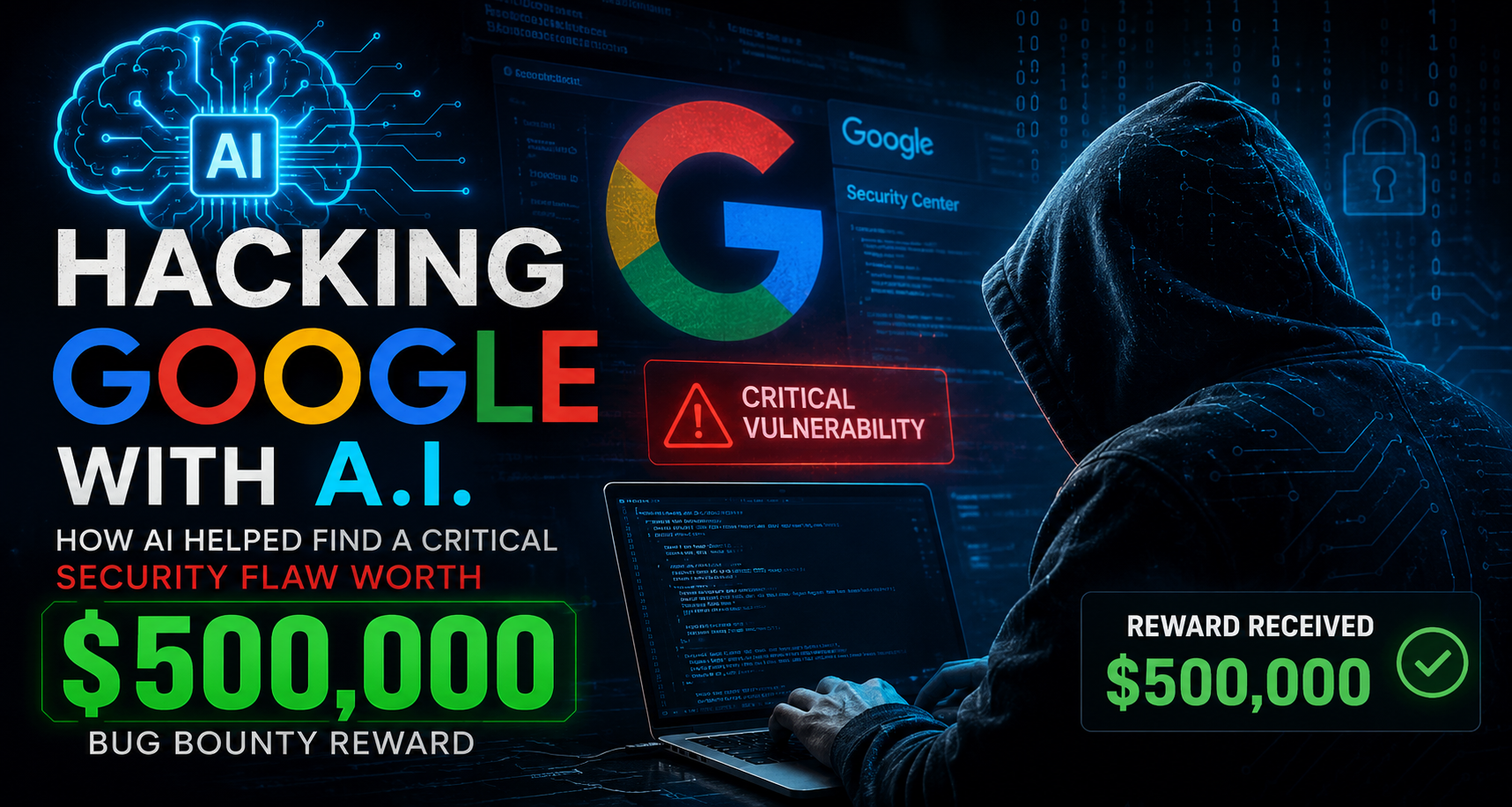
Hacking Google with A.I. for $500,000: How Artificial Intelligence Helped Discover a Critical Security Vulnerability
Artificial Intelligence is rapidly changing the cybersecurity landscape. From automating security operations to helping researchers discover vulnerabilities faster than ever before, AI has become a powerful tool in modern security research. One of the most fascinating examples is the story of how a security researcher leveraged AI techniques to uncover a critical vulnerability affecting Google systems and earned a reward worth $500,000.
In this article, we will explore how AI-assisted security research works, how vulnerability hunting has evolved over the years, the methodology behind finding high-impact security flaws, and the lessons that cybersecurity professionals can learn from this remarkable achievement.
Table of Contents
- 1. Introduction
- 2. Google's Security Ecosystem
- 3. The Rise of AI in Cybersecurity
- 4. How AI Assists Security Researchers
- 5. Understanding Google's Bug Bounty Program
- 6. Modern Vulnerability Research Methodology
- 7. Human Intelligence vs Artificial Intelligence
- 8. Why This Discovery Was Significant
- Continue to Part 2
Introduction
Cybersecurity has always been a constant battle between defenders and attackers. As technology advances, software systems become increasingly complex, creating more opportunities for vulnerabilities to emerge. Security researchers dedicate thousands of hours to identifying these weaknesses before malicious actors can exploit them.
Traditionally, vulnerability research required extensive manual analysis, code review, testing, and experimentation. Researchers would spend days or even weeks examining applications, infrastructure, APIs, and protocols in search of security flaws.
Today, Artificial Intelligence is transforming this process. Modern AI systems can analyze massive amounts of data, identify unusual patterns, suggest attack paths, generate testing strategies, and help researchers discover security issues faster than ever before.
The story behind earning a massive reward from Google demonstrates not only the power of AI but also the importance of human expertise. AI did not replace the researcher; instead, it amplified the researcher's capabilities and accelerated the discovery process.
Google's Security Ecosystem
Google operates one of the largest and most sophisticated technology infrastructures in the world. Its services support billions of users and process enormous amounts of data every day.
Products maintained by Google include:
- Google Search
- Gmail
- Google Drive
- Google Cloud Platform
- Android
- YouTube
- Google Maps
- Chrome Browser
- Workspace Applications
Securing such a large ecosystem is an enormous challenge. Even with thousands of engineers and security professionals, it is impossible to guarantee that every vulnerability will be discovered internally.
This is why Google actively collaborates with the global cybersecurity community through responsible disclosure and bug bounty programs.
Security researchers from around the world continuously test Google's products and infrastructure. When valid vulnerabilities are discovered and responsibly reported, Google rewards researchers financially based on the severity and impact of the findings.
The Rise of AI in Cybersecurity
Artificial Intelligence has become one of the most influential technologies in cybersecurity. While AI is often associated with chatbots and content generation, its applications extend far beyond these use cases.
Security teams use AI for:
- Threat detection
- Malware analysis
- Log analysis
- Incident response
- Fraud detection
- Security monitoring
- Vulnerability assessment
- Behavioral analytics
AI systems excel at processing large volumes of information quickly. They can identify anomalies, classify patterns, and assist analysts in understanding complex environments.
For vulnerability researchers, this means spending less time on repetitive tasks and more time focusing on creative problem-solving.
How AI Assists Security Researchers
Contrary to popular belief, AI does not automatically find critical vulnerabilities on its own. Successful vulnerability research still requires deep technical knowledge, creativity, persistence, and understanding of software architecture.
However, AI can significantly improve efficiency in several areas.
1. Pattern Recognition
AI models can analyze large codebases and identify suspicious patterns that may indicate security weaknesses. Researchers can use these insights to prioritize areas that deserve deeper investigation.
2. Code Understanding
Modern AI systems can help explain complex code structures, APIs, workflows, and logic paths. This allows researchers to understand unfamiliar applications more quickly.
3. Attack Surface Mapping
AI can assist in documenting relationships between components, endpoints, services, and integrations. A better understanding of the attack surface often leads to better vulnerability discovery opportunities.
4. Hypothesis Generation
Security research often begins with hypotheses. Researchers ask questions such as:
- Can this permission be bypassed?
- Can this workflow be manipulated?
- Can data flow into an unintended location?
- Can authentication controls be circumvented?
AI can help generate additional hypotheses, providing researchers with new directions to explore.
5. Data Correlation
Large-scale systems generate massive amounts of information. AI can correlate findings from multiple sources, helping researchers identify relationships that might otherwise remain hidden.
Understanding Google's Bug Bounty Program
Google's Vulnerability Reward Program (VRP) is widely regarded as one of the most successful bug bounty programs in the world.
The program encourages ethical hackers and security researchers to responsibly disclose vulnerabilities affecting Google's products and services.
Rewards vary depending on:
- Severity
- Exploitability
- Impact
- Affected product
- User exposure
- Potential business risk
While many vulnerabilities receive rewards ranging from hundreds to thousands of dollars, exceptionally impactful discoveries can earn significantly larger payouts.
High-value vulnerabilities often involve:
- Account compromise
- Remote code execution
- Authentication bypass
- Privilege escalation
- Large-scale data exposure
- Cloud infrastructure compromise
A reward of $500,000 represents an extraordinarily significant security finding and highlights the importance of the vulnerability discovered.
Modern Vulnerability Research Methodology
Successful security research follows a structured methodology rather than random testing. Researchers typically proceed through several phases:
- Reconnaissance
- Attack Surface Mapping
- Technology Identification
- Threat Modeling
- Hypothesis Creation
- Testing and Validation
- Impact Assessment
- Responsible Disclosure
AI can assist throughout these stages, but human judgment remains essential. Security researchers must verify findings, eliminate false positives, understand business logic, and accurately assess impact.
Human Intelligence vs Artificial Intelligence
One of the most important lessons from this story is that AI is not replacing security researchers. Instead, AI acts as a powerful assistant.
Human researchers bring:
- Creativity
- Critical thinking
- Context awareness
- Business logic understanding
- Strategic reasoning
AI contributes:
- Speed
- Pattern analysis
- Automation
- Large-scale data processing
- Knowledge assistance
The combination of human expertise and AI capabilities creates a highly effective approach to modern security research.
Why This Discovery Was Significant
Vulnerabilities that earn six-figure rewards are rarely simple mistakes. They typically involve complex chains of weaknesses, unexpected interactions between systems, or highly creative exploitation paths.
Such discoveries demonstrate how advanced security research has become. Researchers are no longer limited to traditional manual testing techniques. They now combine automation, AI-assisted analysis, large-scale reconnaissance, and deep technical expertise to uncover vulnerabilities that might otherwise remain hidden.
The $500,000 reward highlights both the value of responsible disclosure and the growing role of AI in cybersecurity innovation.