CVE-2026-44578: Understanding the Next.js WebSocket SSRF Vulnerability
A comprehensive guide to the high-severity Server-Side Request Forgery in Next.js
Published: June 2026 | Updated: June 6, 2026 | Word Count: ~3500+
Table of Contents
- 1. Introduction to CVE-2026-44578
- 2. What is Server-Side Request Forgery (SSRF)?
- 3. Overview of Next.js Framework
- 4. Technical Details of the Vulnerability
- 5. Affected Versions and Scope
- 6. How the Exploit Works
- 7. Potential Impact and Real-World Risks
- 8. Exploitation Scenarios and Examples
- 9. How to Detect if You're Vulnerable
- 10. Mitigation and Patching Strategies
- 11. Security Best Practices for Next.js Applications
- 12. Comparison with Other SSRF Vulnerabilities
- 13. Future Prevention and Lessons Learned
- 14. Frequently Asked Questions (FAQ)
- 15. Conclusion
Key Facts at a Glance:
- Severity: High (CVSS 8.6)
- Type: Server-Side Request Forgery (CWE-918)
- Affected: Self-hosted Next.js apps (not Vercel-hosted)
- Fixed In: Next.js 15.5.16 and 16.2.5
- Discovered: May 2026
1. Introduction to CVE-2026-44578
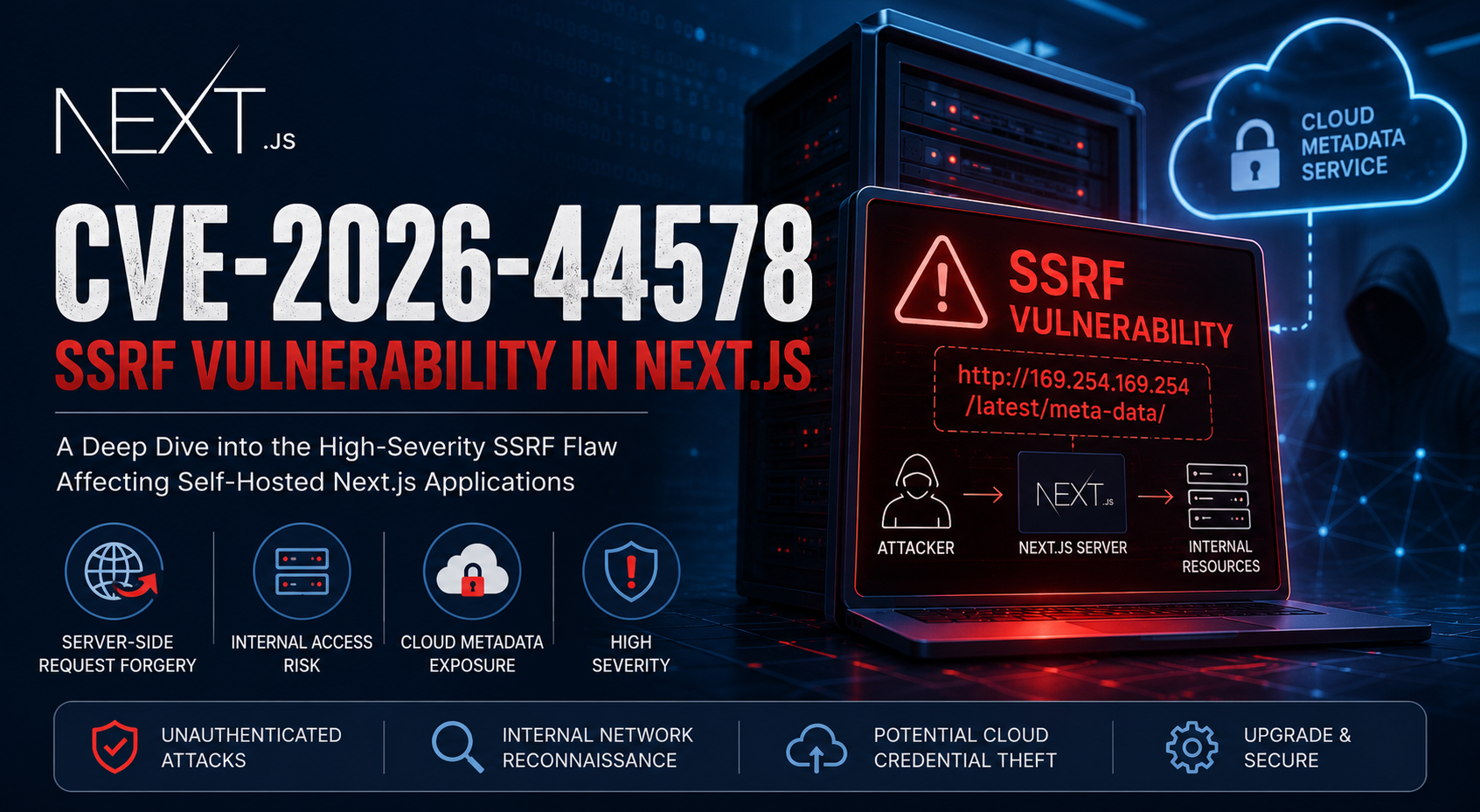
In May 2026, Vercel disclosed CVE-2026-44578, a high-severity Server-Side Request Forgery (SSRF) vulnerability in Next.js. This flaw affects self-hosted deployments using the built-in Node.js server. With a CVSS score of 8.6, it enables unauthenticated attackers to force the server to make requests to internal or external resources.
This comprehensive guide covers everything from fundamentals to advanced mitigation. We will explore the technical root cause, real-world impact, exploitation methods, and long-term lessons for secure development.
Next.js powers millions of applications. Understanding this vulnerability is essential for developers and security teams maintaining self-hosted instances.
2. What is Server-Side Request Forgery (SSRF)?
Server-Side Request Forgery (SSRF) is a critical web vulnerability (CWE-918) that allows attackers to trick server-side code into making unauthorized HTTP requests. These requests can target internal networks, cloud metadata services, or external systems, often bypassing firewalls.
SSRF is dangerous because the requests originate from the trusted server, giving attackers indirect access to protected resources. Common targets include AWS metadata endpoints (169.254.169.254), internal databases, or admin panels.
Common SSRF Attack Vectors
- Internal IP ranges (10.0.0.0/8, 192.168.0.0/16)
- Cloud provider metadata services
- Localhost (127.0.0.1) services
- Internal APIs and databases
In CVE-2026-44578, the attack vector is the WebSocket upgrade handler, making it particularly stealthy.
3. Overview of Next.js Framework
Next.js, developed by Vercel, is one of the most popular React frameworks. It supports server-side rendering, API routes, static generation, and more, making it ideal for production-grade applications.
Key Features of Next.js
The built-in Node.js server in self-hosted setups handles WebSocket upgrades — the exact component vulnerable in CVE-2026-44578.
CVSS Vector: CVSS:3.1/AV:N/AC:L/PR:N/UI:N/S:C/C:H/I:N/A:N
Breakdown: Network attack vector, low complexity, no privileges required, high confidentiality impact.
4. Technical Details of the Vulnerability
The flaw resides in packages/next/src/server/lib/router-server.ts (WebSocket upgrade handler). Insufficient validation of upgrade requests allows attackers to specify arbitrary destinations, turning the server into an open proxy for internal networks.
This was introduced in earlier versions and persisted until the patches in May 2026.
5. Affected Versions and Scope
| Version Range | Status |
|---|---|
| 13.4.13 to <15.5.16 | Vulnerable |
| 16.0.0 to <16.2.5 | Vulnerable |
| 15.5.16+ | Patched |
| 16.2.5+ | Patched |
Vercel-hosted apps are safe. Approximately 79,000 exposed instances were potentially vulnerable before patching.
6. How the Exploit Works
Attackers send a crafted HTTP request with Upgrade: websocket and malicious parameters. The server proxies the request to attacker-controlled internal targets (e.g., metadata services), returning sensitive data.
7. Potential Impact and Real-World Risks
- Cloud credential theft (AWS, GCP, Azure)
- Internal network reconnaissance
- Data exfiltration from databases
- Full server compromise in chained attacks
10. Mitigation and Patching Strategies
Step 1: Upgrade immediately to Next.js 15.5.16 or 16.2.5+.
Step 2: Use a reverse proxy (Nginx) to block unwanted WebSocket upgrades if not required.
Step 3: Restrict outbound network access from the application server.
11. Security Best Practices for Next.js Applications
Regular updates, input validation, network segmentation, WAF usage, and monitoring are key.
14. Frequently Asked Questions (FAQ)
A: No.
A: Very urgent — exploit is public.
15. Conclusion
CVE-2026-44578 reminds us that even popular frameworks need constant security scrutiny. Update now and adopt proactive security practices.