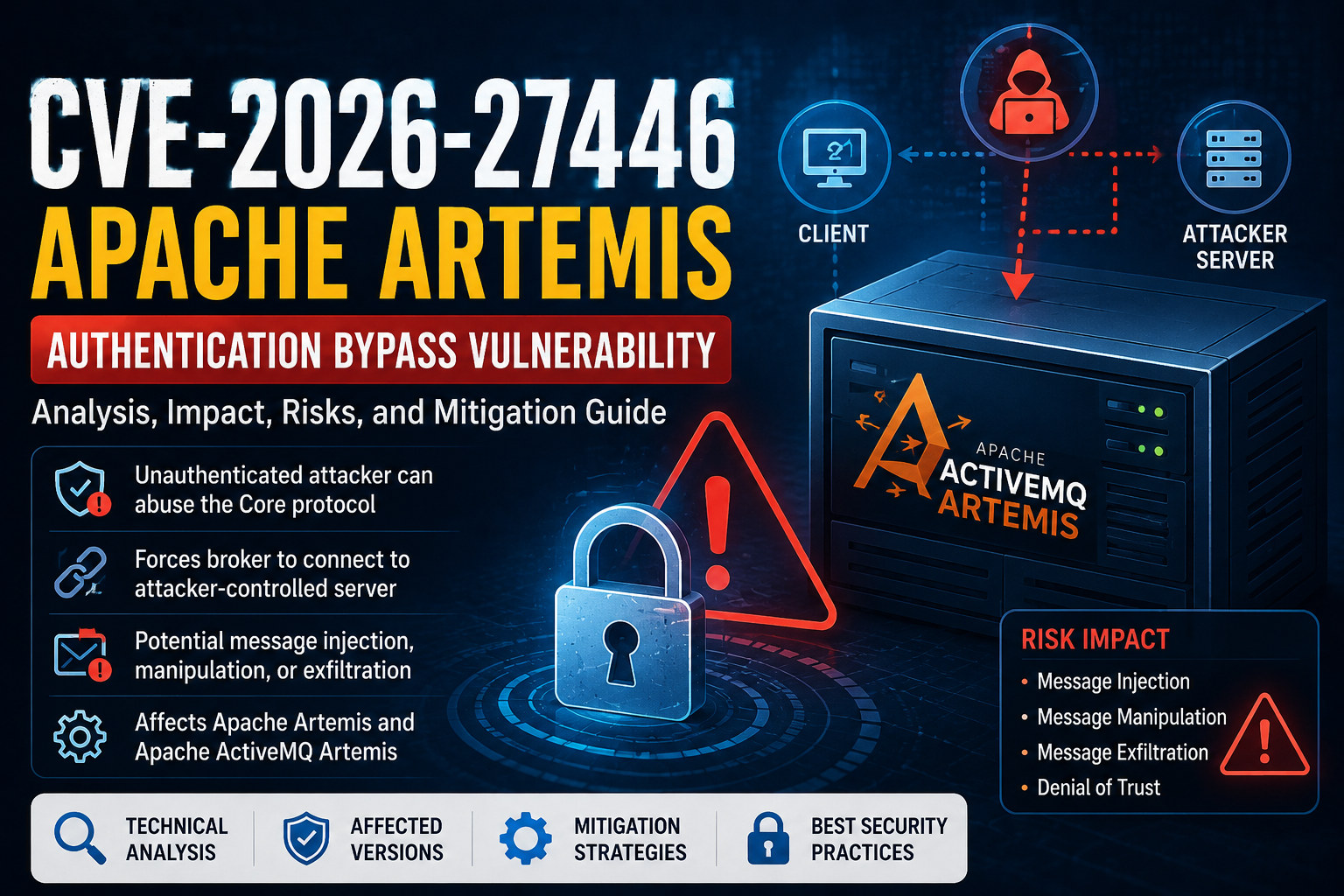
CVE-2026-27446: Complete Analysis of the Apache Artemis Authentication Bypass Vulnerability
Enterprise messaging systems are among the most critical components of modern software infrastructure. They facilitate communication between applications, microservices, cloud platforms, databases, and business systems. When vulnerabilities affect these messaging platforms, the impact can extend far beyond a single application.
CVE-2026-27446 is a significant security vulnerability affecting Apache Artemis and Apache ActiveMQ Artemis. The vulnerability is categorized as a Missing Authentication for Critical Function weakness (CWE-306). An unauthenticated remote attacker can abuse the Core protocol to force a vulnerable broker to establish an outbound federation connection to an attacker-controlled broker. This can potentially lead to message injection, message manipulation, or message exfiltration.
Because messaging brokers often process business-critical information, this vulnerability has attracted attention from security teams, administrators, developers, and organizations that rely on Apache Artemis deployments.
Table of Contents
- 1. Overview of CVE-2026-27446
- 2. What is Apache Artemis?
- 3. Technical Summary
- 4. Affected Versions
- 5. Root Cause Analysis
- 6. Understanding the Core Protocol
- 7. Attack Scenario Explained
- 8. Security Impact
- 9. Enterprise Risk Assessment
- 10. Detection Strategies
- 11. Mitigation and Remediation
- 12. Security Best Practices
- 13. Frequently Asked Questions
- 14. Conclusion
1. Overview of CVE-2026-27446
CVE-2026-27446 is a vulnerability involving missing authentication controls within Apache Artemis and Apache ActiveMQ Artemis. The issue allows a remote, unauthenticated attacker to abuse Core federation functionality under certain deployment conditions.
According to public advisories, the vulnerability allows a target broker to be manipulated into establishing an outbound Core federation connection with a rogue broker controlled by an attacker.
Once this federation relationship is established, attackers may be capable of injecting messages into queues or obtaining messages from queues that should remain protected.
CWE: CWE-306
CVE: CVE-2026-27446
Affected Products: Apache Artemis, Apache ActiveMQ Artemis
Attack Requirement: Network Accessible Broker
Authentication Required: No
2. What is Apache Artemis?
Apache Artemis is a high-performance messaging broker designed for enterprise environments. It supports multiple messaging protocols and provides reliable communication between distributed applications.
Organizations use Apache Artemis for:
- Microservices communication
- Enterprise integration
- Financial transaction processing
- Cloud-native application messaging
- IoT communication platforms
- Real-time data processing
- Business workflow automation
Because messaging systems often handle sensitive operational data, security weaknesses affecting brokers can have widespread consequences.
3. Technical Summary
The vulnerability stems from insufficient authentication protections around Core federation operations. An attacker can interact with the Core protocol and trigger actions that should require stronger validation.
Under vulnerable configurations, the broker may establish an outbound connection to an attacker-controlled broker.
This behavior creates several potential security concerns:
- Unauthorized message access
- Message injection into queues
- Sensitive data exposure
- Manipulation of business workflows
- Potential trust boundary violations
The vulnerability primarily impacts environments that allow incoming Core protocol connections from untrusted sources while also permitting outbound Core protocol connections to untrusted destinations.
4. Affected Versions
Public advisories indicate the following affected versions:
Apache Artemis
- 2.50.0
- 2.51.0
Apache ActiveMQ Artemis
- 2.11.0 through 2.44.0
Administrators are advised to upgrade to fixed releases as soon as practical. Apache Artemis version 2.52.0 contains the official fix for this issue.
5. Root Cause Analysis
At its core, CVE-2026-27446 is an authentication problem.
Authentication serves as the first line of defense for critical system functions. When a security-sensitive feature lacks proper authentication, attackers may be able to invoke operations that should only be available to trusted entities.
In this case, federation-related functionality could be manipulated before sufficient authentication checks were enforced.
The weakness falls under CWE-306, which is specifically associated with missing authentication for critical functions.
6. Understanding the Core Protocol
Apache Artemis supports multiple communication protocols, one of which is the Core protocol.
The Core protocol is designed to provide efficient communication between brokers and clients. It plays an important role in message transport, federation operations, and distributed messaging environments.
Because federation allows brokers to share and distribute messages across environments, it is essential that federation-related actions are protected with strong authentication and authorization controls.
When those controls are insufficient, trust assumptions within the messaging architecture can break down.
Next Part: Attack Flow, Exploitation Scenarios, Message Injection Risks, Message Exfiltration Risks, Enterprise Impact, Detection Strategies, Threat Hunting, and Security Monitoring.
7. Attack Scenario Explained
To understand the real-world significance of CVE-2026-27446, it is useful to examine how a vulnerable deployment could potentially be abused by an attacker.
Modern enterprise messaging infrastructures frequently consist of multiple brokers distributed across cloud environments, data centers, regional offices, and application clusters. Federation features help these brokers exchange messages efficiently.
The vulnerability arises when federation-related functionality can be triggered without sufficient authentication controls.
Stage 1: Discovery
An attacker first identifies a publicly accessible Apache Artemis broker. This could occur through internet scanning, security assessments, exposed services, or routine reconnaissance activities.
If the broker accepts incoming Core protocol connections from external networks, it may become a target for further investigation.
Stage 2: Interaction with the Core Protocol
The attacker interacts with the Core protocol and attempts to abuse federation-related functionality.
Due to the authentication weakness, certain security-sensitive operations may occur without the validation that administrators would normally expect.
Stage 3: Outbound Federation Connection
The vulnerable broker may establish an outbound federation connection to infrastructure controlled by the attacker.
This changes the trust relationship between systems and creates a path through which messages could potentially flow.
Stage 4: Unauthorized Data Access
Once a federation relationship exists, attackers may attempt to access, intercept, inject, or manipulate messages depending on deployment configuration and permissions.
Stage 5: Operational Impact
Sensitive business information, workflow messages, integration events, and application communications could become exposed or altered.
8. Security Impact Analysis
The impact of CVE-2026-27446 depends heavily on deployment architecture, network exposure, federation configuration, and the sensitivity of information flowing through the broker.
Although every environment is different, organizations should carefully evaluate several risk categories.
Confidentiality Impact
Confidentiality refers to protecting information from unauthorized access.
Messaging systems commonly carry:
- Customer information
- Business transactions
- Application events
- Authentication workflows
- Financial data
- Operational telemetry
- Integration messages
Unauthorized access to these messages may expose sensitive information and increase compliance risks.
Integrity Impact
Integrity focuses on ensuring that information remains accurate and unmodified.
Message injection or manipulation can affect business processes, application behavior, and automated workflows.
Even a small amount of unauthorized message modification can create operational confusion or inaccurate business outcomes.
Availability Impact
Messaging infrastructure is often a critical dependency for enterprise applications.
If messaging systems become unstable or overloaded because of malicious activity, application performance may suffer.
In large environments, messaging disruptions can affect numerous interconnected services simultaneously.
Trust Relationship Impact
One of the most significant risks associated with federation-based vulnerabilities involves trust relationships.
Organizations typically assume that communication between federated brokers originates from trusted systems.
If attackers can interfere with these relationships, the security assumptions underlying the architecture may no longer hold true.
9. Enterprise Risk Assessment
Enterprise environments often depend on messaging brokers as foundational infrastructure components.
A single broker may support:
- Order processing systems
- Financial applications
- Customer service platforms
- Microservices architectures
- Cloud integrations
- Data synchronization services
- Monitoring solutions
Because of this central role, vulnerabilities affecting messaging brokers frequently have a larger blast radius than organizations initially expect.
Financial Sector Risks
Banks, payment processors, insurance providers, and financial institutions commonly use messaging platforms for transaction processing.
Unauthorized access to transaction-related messages may create regulatory, operational, and reputational concerns.
Healthcare Sector Risks
Healthcare organizations often rely on messaging infrastructure to connect clinical systems, patient portals, and operational applications.
Exposure of sensitive healthcare-related messages could introduce compliance and privacy challenges.
Cloud-Native Risks
Cloud-native architectures increasingly depend on event-driven messaging.
In these environments, message brokers act as central communication hubs, making them attractive targets for attackers.
Supply Chain Risks
Many organizations integrate with external vendors, partners, and service providers through messaging systems.
Any compromise affecting broker communications may indirectly influence connected business processes.
10. Detection and Monitoring Strategies
Early detection plays an important role in reducing the impact of security incidents.
Organizations should implement layered monitoring capabilities to identify suspicious federation activity.
Monitor Federation Connections
Administrators should review broker logs for unusual federation relationships, unexpected destinations, or unexplained outbound connections.
Any federation relationship that was not explicitly approved should be investigated.
Analyze Broker Logs
Broker logs frequently provide valuable forensic evidence.
Security teams should examine:
- Connection events
- Federation activity
- Authentication failures
- Configuration changes
- Unexpected message routing
Network Monitoring
Network monitoring tools can help identify unusual outbound communication originating from messaging brokers.
Baseline traffic patterns should be established so deviations become easier to detect.
Security Information and Event Management (SIEM)
Centralized logging and SIEM platforms can correlate activity across multiple systems.
Correlation rules may help identify suspicious combinations of:
- Broker activity
- Network connections
- User actions
- Configuration changes
- Application events
Threat Hunting
Proactive threat hunting can help uncover malicious activity that traditional alerts fail to detect.
Security analysts should periodically review messaging infrastructure for unusual communication patterns and unauthorized relationships.
Incident Investigation
If exploitation is suspected, organizations should collect relevant logs, preserve evidence, review federation configurations, and determine whether sensitive messages may have been exposed.
Next Part: Mitigation Strategies, Patching Guidance, Security Hardening, Best Practices, Developer Lessons, FAQ Section, Conclusion, Meta Description, SEO Elements, and Structured Data.
11. Mitigation and Remediation Strategies
Addressing CVE-2026-27446 requires a combination of patch management, network security controls, configuration reviews, and ongoing monitoring.
While applying vendor-provided fixes should be the highest priority, organizations should also review their messaging architecture to reduce future risk.
Upgrade to a Fixed Version
The most effective mitigation is upgrading to a version that includes the official security fix.
Apache Artemis version 2.52.0 addresses the vulnerability and should be deployed according to organizational change management procedures.
Security patches are most effective when deployed quickly and consistently across all affected environments.
Restrict Network Access
Messaging brokers should not be exposed directly to untrusted networks unless absolutely necessary.
Access controls, firewalls, and network segmentation can significantly reduce the attack surface.
- Limit broker exposure to trusted networks.
- Restrict Core protocol access.
- Review firewall rules regularly.
- Separate production and development environments.
- Implement network segmentation.
Review Federation Configurations
Organizations should inventory all federation relationships and confirm that every configured destination is legitimate and approved.
Unnecessary federation connections should be removed to reduce complexity and risk.
Strengthen Authentication Controls
Authentication and authorization mechanisms should be reviewed to ensure only trusted systems can establish federation relationships.
Strong identity verification remains one of the most effective security controls available.
Implement Continuous Monitoring
Security teams should continuously monitor broker activity and maintain visibility into federation operations.
Early detection often prevents small incidents from becoming major security events.
12. Security Best Practices for Apache Artemis Deployments
Although CVE-2026-27446 highlights a specific security issue, it also reinforces broader security principles that apply to all messaging infrastructure.
Principle of Least Privilege
Every user, service account, and application should have only the permissions necessary to perform required tasks.
Excessive privileges increase the potential impact of security incidents.
Zero Trust Principles
Modern security strategies increasingly adopt zero trust approaches.
Under a zero trust model, no system is automatically trusted simply because it resides inside the corporate network.
Verification should occur continuously.
Secure Configuration Management
Configuration drift is a common source of security weaknesses.
Organizations should maintain documented configuration standards and regularly review deployments for compliance.
Security Auditing
Periodic audits help identify security gaps before attackers discover them.
Audit activities should include:
- Access reviews
- Configuration reviews
- Network exposure assessments
- Patch verification
- Security control validation
Secure Software Development
Development teams should incorporate security reviews throughout the software development lifecycle.
Security testing should become a routine part of deployment processes.
Backup and Recovery Planning
Security incidents can affect availability and data integrity.
Organizations should maintain tested backup and recovery procedures to ensure business continuity.
13. Lessons for Security Teams and Developers
CVE-2026-27446 provides several valuable lessons for developers, administrators, and security professionals.
Authentication Matters
Critical functions should never be exposed without proper authentication.
Even seemingly small authentication gaps can create significant security risks when exploited by attackers.
Trust Relationships Require Protection
Federation, synchronization, and integration features often involve trust relationships between systems.
These relationships must be protected through strong authentication, authorization, and monitoring controls.
Security Reviews Should Be Continuous
Security is not a one-time activity.
Continuous assessment helps organizations identify emerging risks before they are exploited.
Visibility Is Essential
Effective monitoring provides organizations with the information necessary to detect suspicious behavior and respond quickly.
Security teams cannot protect what they cannot see.
14. Frequently Asked Questions (FAQ)
What is CVE-2026-27446?
CVE-2026-27446 is a missing authentication vulnerability affecting Apache Artemis and Apache ActiveMQ Artemis. It can allow a broker to establish unauthorized federation connections under certain conditions.
What type of vulnerability is CVE-2026-27446?
It is classified as CWE-306, Missing Authentication for Critical Function.
Is authentication required for exploitation?
Public advisories indicate that exploitation may be possible without prior authentication when the vulnerable conditions are present.
Which products are affected?
Apache Artemis and Apache ActiveMQ Artemis deployments running affected versions are impacted.
What is the primary security risk?
The primary risk involves unauthorized federation connections that could lead to message exposure, message injection, or message manipulation.
How can organizations protect themselves?
Upgrade affected systems, restrict network access, review federation configurations, strengthen authentication controls, and continuously monitor broker activity.
Is patching sufficient?
Patching is essential, but organizations should also implement layered security controls and monitoring capabilities.
15. Conclusion
CVE-2026-27446 highlights the importance of strong authentication controls within enterprise messaging systems. Apache Artemis and Apache ActiveMQ Artemis are widely deployed technologies that serve critical business functions across numerous industries.
The vulnerability demonstrates how missing authentication for a critical function can create opportunities for unauthorized federation connections and potentially expose sensitive messaging workflows.
Organizations should promptly assess affected deployments, apply available security updates, review federation configurations, and strengthen network security controls.
Security teams should also use this vulnerability as an opportunity to evaluate broader messaging infrastructure security practices, including access control policies, monitoring capabilities, patch management processes, and incident response readiness.
By combining proactive security measures, continuous monitoring, secure configuration management, and timely patch deployment, organizations can significantly reduce their exposure to messaging-related security threats.
As enterprise systems continue to grow more interconnected, protecting communication infrastructure will remain a critical component of modern cybersecurity strategies.
SEO Meta Description
Learn everything about CVE-2026-27446, an Apache Artemis authentication bypass vulnerability. Explore affected versions, technical analysis, security risks, message injection concerns, detection methods, mitigation strategies, and security best practices.
Focus Keywords
CVE-2026-27446, Apache Artemis vulnerability, Apache ActiveMQ Artemis security flaw, CVE-2026-27446 analysis, authentication bypass vulnerability, CWE-306, messaging broker security, Apache Artemis security update, enterprise messaging security, message injection vulnerability, message exfiltration risk, federation security, Apache Artemis patch, ActiveMQ Artemis vulnerability, cybersecurity analysis, vulnerability management, broker security best practices, security hardening guide, enterprise cybersecurity, messaging infrastructure protection.