Telegram App Blocked in India Till June 22 Over NEET Paper Leak Worries: Complete Analysis
Published: June 2026 | Education News | Technology News | NEET Updates
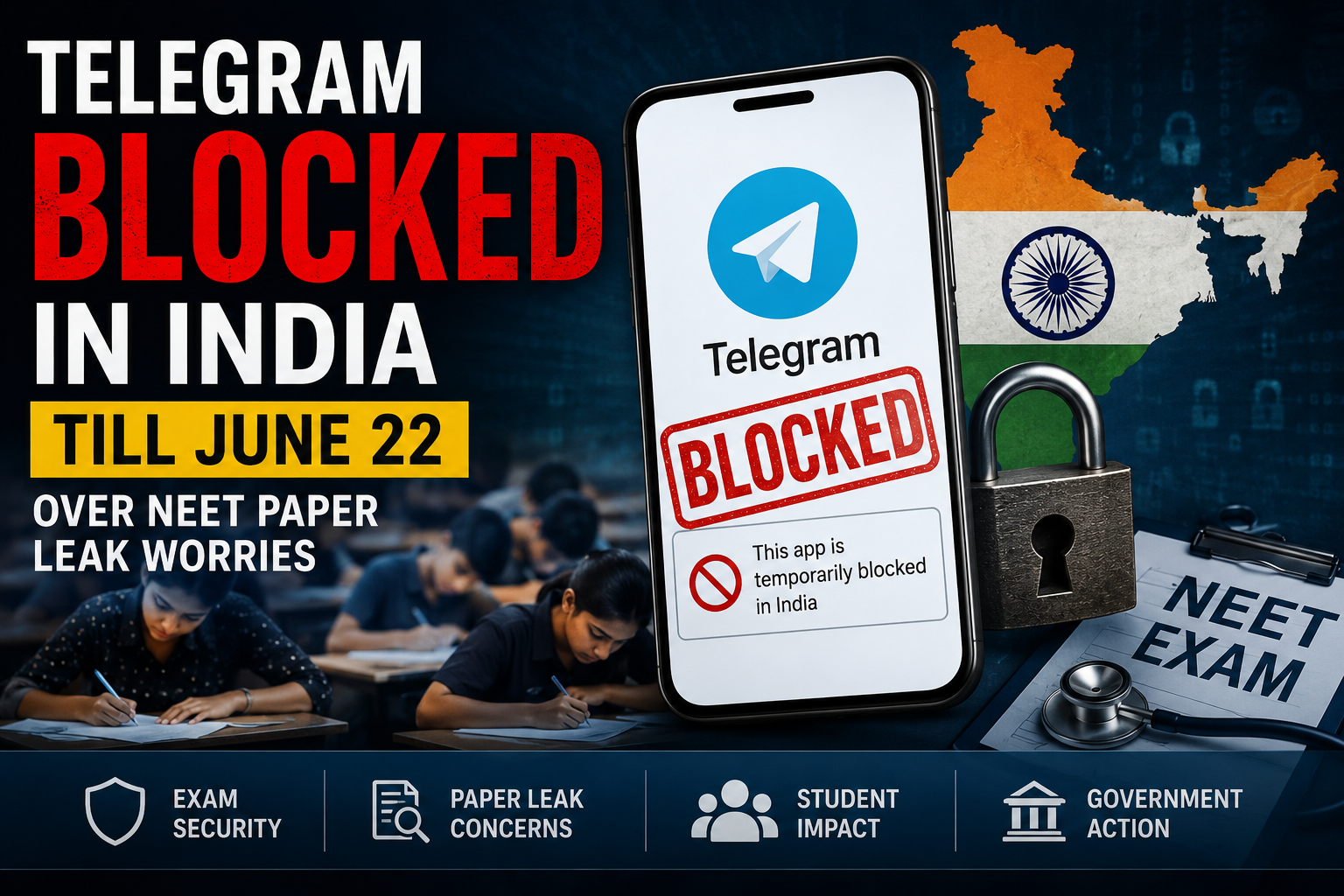
The Government of India recently announced a temporary restriction on the Telegram messaging application until June 22, 2026. The decision was taken ahead of the NEET (UG) 2026 re-examination scheduled for June 21. Authorities believe that Telegram was being misused by cheating networks, misinformation groups, and individuals involved in exam-related fraud activities. The move has generated significant debate among students, educators, technology experts, digital rights activists, and millions of Telegram users across the country. According to official statements, the restriction aims to protect the integrity of the examination process and prevent the spread of fake question papers, rumors, and fraudulent claims related to the examination. :contentReference[oaicite:0]{index=0}
NEET is one of India's most important entrance examinations for students aspiring to pursue medical education. Any disruption, controversy, or paper leak associated with the examination affects millions of candidates and their families. As a result, authorities have implemented strict measures to maintain fairness and transparency. The temporary Telegram restriction is one such measure designed to reduce opportunities for organized cheating and misinformation campaigns. :contentReference[oaicite:1]{index=1}
Table of Contents
- 1. Overview of the Telegram Restriction
- 2. Why Was Telegram Blocked?
- 3. Background of the NEET Paper Leak Controversy
- 4. Telegram's Role in Exam-Related Information Sharing
- 5. Government's Response and Legal Basis
- 6. Impact on Students
- 7. Impact on Teachers and Coaching Institutes
- 8. Impact on Businesses and Communities
- 9. Security and Digital Governance Concerns
- 10. Criticism and Controversies
- 11. Future Implications
- 12. Conclusion
1. Overview of the Telegram Restriction
Telegram is one of the world's most popular messaging applications, known for its large channels, groups, cloud-based architecture, and privacy-focused features. In India, millions of users rely on Telegram for communication, educational content, professional networking, news updates, and community discussions.
However, authorities alleged that some individuals and organized groups were using the platform to distribute misleading information, fake examination materials, and potentially facilitate examination fraud. To address these concerns, the Ministry of Electronics and Information Technology (MeitY), acting on recommendations from the National Testing Agency (NTA), implemented a temporary restriction on Telegram access in India until June 22, 2026. :contentReference[oaicite:2]{index=2}
The restriction is temporary and specifically linked to the NEET re-examination process. Officials stated that the action was intended to prevent disruptions, misinformation campaigns, and fraudulent activities during a critical examination period. :contentReference[oaicite:3]{index=3}
2. Why Was Telegram Blocked?
Several reasons contributed to the government's decision. The primary concern was the alleged use of Telegram by cheating networks attempting to exploit students appearing for the NEET re-examination. Authorities reported that various groups were circulating claims of leaked question papers and promising access to confidential examination materials.
Investigation agencies reportedly discovered organized efforts to mislead candidates through edited messages, fabricated screenshots, and fraudulent promises. Such activities not only create confusion but also increase stress among students who are already preparing for a highly competitive examination. :contentReference[oaicite:4]{index=4}
Another concern involved Telegram's message-editing capability. Officials stated that this feature could be misused to alter message timestamps and contents, potentially creating false evidence suggesting that exam questions had been leaked before the examination. To address this issue, authorities reportedly directed Telegram to disable certain editing functionalities temporarily within India. :contentReference[oaicite:5]{index=5}
3. Background of the NEET Paper Leak Controversy
The NEET examination has faced multiple controversies over the years, with allegations ranging from unfair practices to paper leaks and examination misconduct. The 2026 examination cycle became particularly controversial after reports emerged regarding possible paper leak incidents, resulting in widespread concern among students, parents, educational institutions, and policymakers.
Due to the seriousness of these allegations, authorities launched investigations and introduced additional security measures. The National Testing Agency emphasized that maintaining the integrity of the examination process was essential because millions of students depend on NEET scores for admission to medical colleges across India. :contentReference[oaicite:6]{index=6}
The controversy eventually led to the scheduling of a re-examination for affected candidates. As the re-exam date approached, authorities increased monitoring efforts to prevent any recurrence of similar incidents.
4. Telegram's Role in Exam-Related Information Sharing
Telegram has become a popular platform among students due to its ability to host large groups and channels. Educational institutions, coaching centers, and independent educators frequently use Telegram to share notes, mock tests, study materials, lecture recordings, and examination updates.
While these legitimate uses benefit students, the platform's large-scale communication capabilities can also be exploited by malicious actors. Fraudsters often create channels claiming to provide leaked examination papers, answer keys, or insider information. In many cases, such claims are entirely fake and are used to scam students by demanding payments.
Reports before the NEET re-examination suggested that certain Telegram groups were advertising alleged access to examination materials. Although authorities stated that many of these claims were fraudulent, the existence of such channels contributed to concerns regarding exam security. :contentReference[oaicite:7]{index=7}
5. Government's Response and Legal Basis
The temporary restriction on Telegram was introduced as part of a broader effort to protect the integrity of the NEET re-examination process. Government agencies, examination authorities, cybersecurity teams, and law enforcement organizations coordinated to identify potential threats that could affect the fairness of the examination.
According to officials, the primary objective was not to permanently ban Telegram but to reduce the risk of misinformation, fake paper leak claims, fraudulent activities, and organized cheating attempts during a highly sensitive examination period. Authorities emphasized that extraordinary circumstances sometimes require temporary preventive measures to maintain public trust in national-level examinations.
The National Testing Agency (NTA) has repeatedly highlighted the importance of ensuring equal opportunities for all candidates. Any leak, rumor, or manipulation of examination-related information can create panic among students and undermine confidence in the examination system.
Legal experts note that governments worldwide occasionally impose temporary restrictions on specific digital platforms during emergencies, public security concerns, or large-scale examination events. Such measures are generally evaluated based on their necessity, duration, and proportionality.
In the case of the Telegram restriction, authorities argued that the measure was temporary, targeted, and directly linked to examination security concerns. The restriction was scheduled to remain in place only until June 22, immediately after the completion of the NEET re-examination process.
Government agencies also increased monitoring of social media platforms, messaging services, and online forums to identify fake claims regarding leaked question papers. Officials warned students against trusting unverified sources and encouraged them to rely only on official announcements from examination authorities.
Key Objectives Behind the Restriction
- Prevent circulation of fake question papers.
- Reduce misinformation and rumors.
- Protect examination integrity.
- Prevent organized cheating networks.
- Maintain public confidence in NEET.
- Ensure equal opportunities for all candidates.
6. Impact on Students
Students are the most directly affected group whenever major examination-related decisions are made. Since Telegram is widely used by learners across India, the temporary restriction created both advantages and challenges.
Many students rely on Telegram for study groups, educational discussions, lecture recordings, daily quizzes, practice questions, and examination updates. As a result, some candidates experienced temporary disruptions in their preparation routines.
However, supporters of the restriction argue that protecting the credibility of the examination is more important than short-term inconvenience. If even a small number of candidates gain unfair advantages through leaked materials or organized cheating, the efforts of millions of honest students may be negatively affected.
For students preparing for competitive examinations, fairness is extremely important. The value of a competitive examination depends on every participant having equal access to legitimate resources and opportunities.
Challenges Faced by Students
- Temporary loss of access to study groups.
- Difficulty accessing shared educational resources.
- Disruption of coaching institute communication channels.
- Confusion regarding examination-related announcements.
- Increased dependence on alternative platforms.
Potential Benefits for Students
- Reduced exposure to fake paper leak claims.
- Lower risk of scams targeting candidates.
- Improved examination fairness.
- Greater trust in examination outcomes.
- Protection from misinformation campaigns.
Education experts generally advise students to avoid unofficial sources claiming access to examination papers. Such claims are often fraudulent and may lead to financial losses, emotional stress, or legal consequences.
7. Impact on Teachers and Coaching Institutes
Coaching institutes, private educators, and academic mentors have increasingly adopted Telegram as a communication platform. Many educational organizations use Telegram channels to distribute notes, assignments, mock tests, recorded lectures, and important updates.
The temporary restriction required many institutions to quickly switch to alternative communication channels such as WhatsApp, email newsletters, learning management systems (LMS), websites, and video conferencing platforms.
While the disruption lasted only a short period, it highlighted the risks associated with relying heavily on a single digital platform for educational communication.
Many educators used the situation as an opportunity to diversify their communication methods and establish backup channels for distributing educational content.
Effects on Coaching Institutes
- Need to migrate educational content temporarily.
- Communication delays with students.
- Additional administrative workload.
- Requirement to use alternative messaging platforms.
- Adjustment of online teaching workflows.
Despite these challenges, many institutions supported efforts aimed at protecting examination integrity. Educational organizations often emphasize that fair examinations ultimately benefit both students and academic institutions.
Lessons for Educational Organizations
- Maintain multiple communication channels.
- Create backup systems for content distribution.
- Verify information before sharing with students.
- Educate learners about misinformation risks.
- Strengthen cybersecurity awareness programs.
8. Impact on Businesses and Communities
Telegram is not used exclusively for educational purposes. Millions of businesses, content creators, freelancers, startups, digital marketers, and online communities depend on the platform for communication and audience engagement.
As a result, the temporary restriction affected a wide variety of users beyond the education sector. Small businesses that operate customer support groups, marketing channels, and community forums experienced interruptions in their normal operations.
Content creators who regularly share updates through Telegram channels had to redirect their audiences to alternative platforms. Similarly, technology communities, cryptocurrency groups, programming communities, and professional networks experienced temporary communication challenges.
However, because the restriction was announced as a short-term measure, many organizations viewed it as a manageable disruption rather than a long-term operational threat.
Industries Potentially Affected
- Online education providers.
- Digital marketing agencies.
- Content creators and influencers.
- Technology communities.
- Startup ecosystems.
- Customer support groups.
- Freelancer networks.
- Subscription-based communities.
How Businesses Adapted
- Migration to alternative messaging platforms.
- Increased use of email communication.
- Utilization of official websites and blogs.
- Temporary use of social media channels.
- Expansion of mobile application notifications.
The incident serves as a reminder that organizations should avoid overdependence on a single communication platform. Diversification improves resilience and ensures continuity during unexpected disruptions.
Additionally, the event reignited discussions regarding digital platform governance, national cybersecurity strategies, and the responsibilities of technology companies in preventing misuse of their services.
9. Security and Digital Governance Concerns
The temporary restriction on Telegram has sparked broader discussions about digital governance, cybersecurity, platform responsibility, and the challenges governments face when attempting to balance public interest with digital freedom.
Modern messaging applications provide powerful communication capabilities that can benefit society in numerous ways. They help people share information instantly, build communities, collaborate professionally, and access educational resources. However, these same features can sometimes be misused by malicious actors to spread misinformation, conduct scams, coordinate illegal activities, or exploit vulnerable individuals.
In the context of competitive examinations, authorities are increasingly concerned about the use of encrypted messaging platforms to distribute fake examination papers, fraudulent answer keys, and misleading information. Even when such content is fake, it can cause panic among students and damage trust in the examination process.
Cybersecurity experts often emphasize that technology itself is neither good nor bad. The real challenge lies in preventing misuse while preserving legitimate use cases. Governments, technology companies, educators, and users all share responsibility for creating a safer digital environment.
Major Digital Security Challenges
- Spread of misinformation and fake news.
- Distribution of fraudulent examination materials.
- Online scams targeting students.
- Identity impersonation and fake accounts.
- Large-scale rumor campaigns.
- Privacy and encryption concerns.
- Cross-border digital crime networks.
The Telegram incident highlights how governments and technology platforms must continuously adapt to emerging digital threats. As communication technologies evolve, examination authorities are also expected to implement more advanced security measures to protect academic integrity.
10. Criticism and Controversies
While many individuals supported the temporary restriction, others criticized the decision. Digital rights advocates, technology experts, and some users argued that restricting access to an entire platform may affect millions of legitimate users who have no connection to examination-related misconduct.
Critics suggested that authorities should focus on identifying specific groups, channels, or individuals responsible for spreading misinformation rather than imposing broader restrictions that impact unrelated communities and businesses.
Another concern raised by critics relates to digital freedom and access to information. Messaging platforms play a significant role in education, professional communication, and business operations. Temporary restrictions can therefore create inconvenience for users who depend on such services for daily activities.
On the other hand, supporters of the government's action argue that extraordinary circumstances require strong preventive measures. They believe that preserving the fairness of a national-level examination affecting millions of students justifies temporary intervention when credible threats are identified.
Arguments Supporting the Restriction
- Protection of examination integrity.
- Prevention of misinformation campaigns.
- Reduction of student anxiety caused by fake leaks.
- Disruption of organized cheating networks.
- Temporary and limited duration of the restriction.
Arguments Opposing the Restriction
- Impact on legitimate users and communities.
- Business and educational disruptions.
- Concerns regarding digital freedom.
- Questions about proportionality of the response.
- Preference for targeted enforcement actions.
The debate demonstrates the complexity of managing digital platforms in an increasingly connected world. Policymakers must often balance competing priorities, including security, privacy, accessibility, and individual rights.
11. Future Implications
The Telegram restriction may have long-term implications for examination security, platform governance, and digital communication policies in India. Educational authorities are likely to invest more heavily in technologies and procedures designed to detect and prevent examination-related fraud.
Artificial intelligence, data analytics, behavioral monitoring systems, and advanced cybersecurity tools may become increasingly important in identifying suspicious activities before they can affect examination processes.
Technology companies may also face greater pressure to cooperate with governments when addressing large-scale misinformation campaigns, fraud networks, and examination-related misconduct. This could lead to stronger moderation systems, improved reporting mechanisms, and enhanced transparency measures.
Educational institutions are expected to learn valuable lessons from the incident as well. Many organizations may diversify their communication infrastructure and reduce dependence on a single platform for distributing educational content.
Possible Future Developments
- Stronger examination security frameworks.
- Advanced fraud detection technologies.
- Improved collaboration between platforms and authorities.
- Enhanced digital literacy programs for students.
- Greater investment in cybersecurity monitoring.
- Development of alternative educational communication systems.
- More comprehensive misinformation prevention strategies.
Regardless of differing opinions regarding the restriction, the event has highlighted the growing importance of digital trust and information integrity in modern education systems.
12. Conclusion
The temporary restriction of Telegram in India until June 22, 2026, represents a significant intersection of education, technology, cybersecurity, and public policy. The decision was introduced amid concerns regarding potential misuse of the platform during the NEET re-examination process and reflects the increasing challenges authorities face in protecting large-scale examinations from misinformation and fraud.
For students, the restriction created temporary inconveniences but was intended to preserve fairness and maintain confidence in the examination system. For educators and coaching institutes, it highlighted the importance of maintaining multiple communication channels. For businesses and communities, it served as a reminder of the risks associated with relying too heavily on a single digital platform.
The broader discussion extends beyond Telegram itself. It raises important questions about digital governance, platform accountability, cybersecurity, misinformation management, and the future of online communication in a rapidly evolving technological landscape.
As India continues to modernize its educational infrastructure and strengthen examination security, policymakers, technology companies, educational institutions, and users will need to work together to create systems that are secure, transparent, fair, and resilient.
Ultimately, the goal remains clear: ensuring that every student has an equal opportunity to succeed based on merit, effort, and genuine achievement rather than misinformation, fraud, or unfair advantages.
Frequently Asked Questions (FAQs)
SEO Meta Description
Learn why Telegram was temporarily blocked in India until June 22 over NEET paper leak concerns. Explore the impact on students, educators, businesses, cybersecurity, digital governance, and future examination security measures.
Suggested SEO Keywords
Telegram blocked in India, Telegram NEET paper leak, NEET 2026 controversy, Telegram ban June 22, NEET exam security, India education news, Telegram restriction analysis, examination fraud prevention, NEET re-exam updates, digital governance India, cybersecurity and education, Telegram controversy explained.