CVE-2026-24289: Complete Technical Analysis of the Windows Kernel Elevation of Privilege Vulnerability
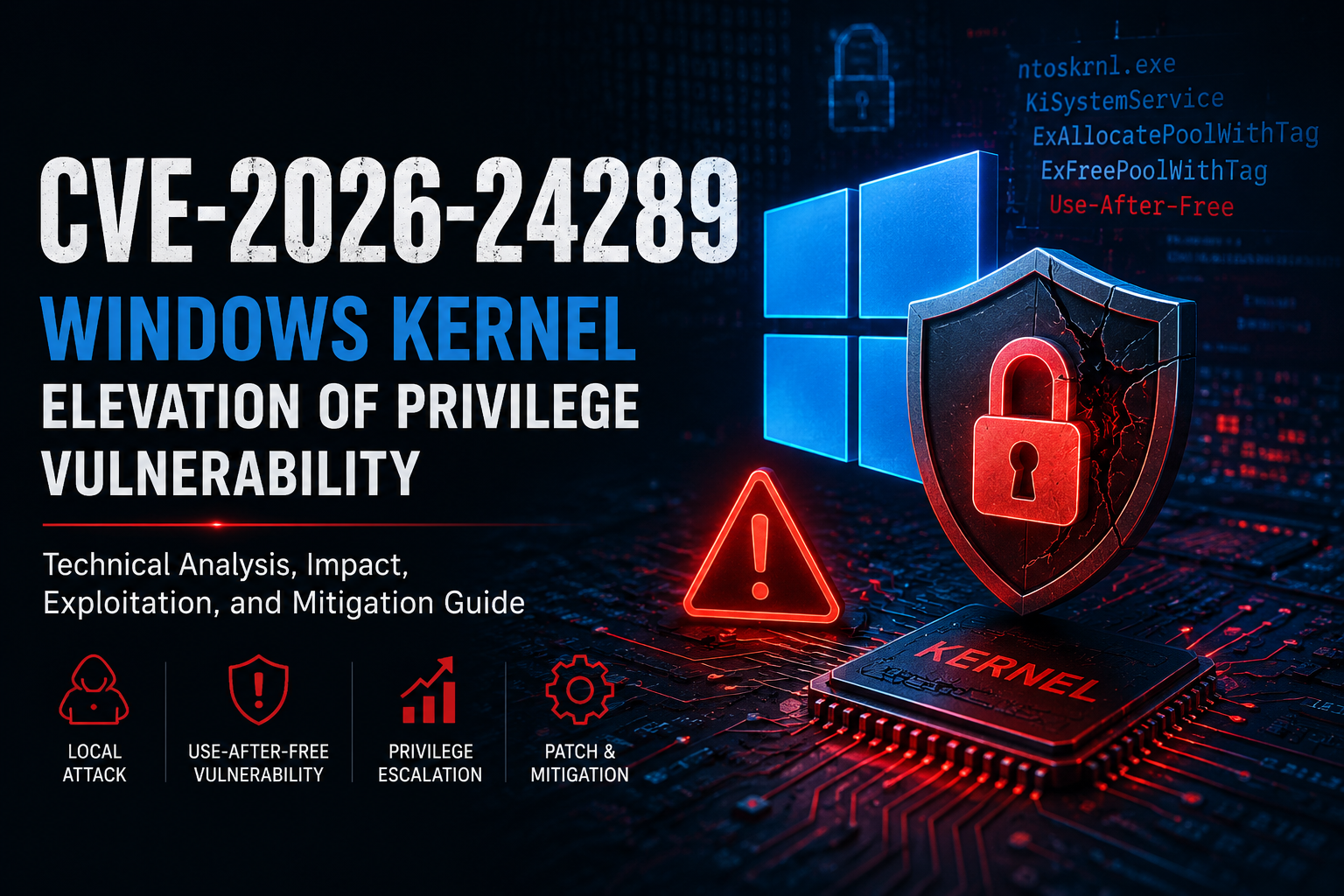
Cybersecurity vulnerabilities continue to evolve every year, and Microsoft Windows remains one of the most targeted operating systems worldwide. In March 2026, Microsoft disclosed a new security issue tracked as CVE-2026-24289. The vulnerability affects the Windows Kernel and has been classified as an Elevation of Privilege (EoP) vulnerability caused by a Use-After-Free memory management flaw.
While this vulnerability does not allow remote code execution directly, it can potentially help attackers gain higher privileges on a compromised system. Security professionals, system administrators, SOC analysts, penetration testers, and enterprise organizations should understand the risks associated with this vulnerability and ensure that affected systems are updated as soon as possible.
In this comprehensive guide, we will explain everything about CVE-2026-24289 in simple language, including how the vulnerability works, affected systems, possible attack scenarios, mitigation strategies, patch management recommendations, detection techniques, and security best practices.
Table of Contents
- 1. Overview of CVE-2026-24289
- 2. What is an Elevation of Privilege Vulnerability?
- 3. Understanding the Windows Kernel
- 4. Understanding Use-After-Free Vulnerabilities
- 5. Technical Summary of CVE-2026-24289
- 6. Severity Assessment
- 7. Possible Attack Scenarios
- 8. Affected Windows Versions
- 9. Security Impact Analysis
- 10. Detection and Monitoring
- 11. Mitigation Strategies
- 12. Microsoft Security Updates
- 13. Security Best Practices
- 14. Conclusion
1. Overview of CVE-2026-24289
CVE-2026-24289 is a Windows Kernel Elevation of Privilege vulnerability disclosed by Microsoft in March 2026. Public vulnerability databases describe the issue as a Use-After-Free vulnerability within the Windows Kernel that could allow an authenticated attacker to elevate privileges locally.
In practical terms, an attacker must already have access to the target system before attempting exploitation. The vulnerability cannot generally be exploited remotely through a simple network connection. Instead, it becomes dangerous when combined with another attack vector such as phishing, malware execution, compromised user accounts, or initial access vulnerabilities.
Once exploited successfully, the attacker may obtain elevated privileges that could enable greater control over the affected system.
| CVE ID | CVE-2026-24289 |
|---|---|
| Vendor | Microsoft |
| Component | Windows Kernel |
| Weakness Type | Use After Free (CWE-416) |
| Impact | Elevation of Privilege |
| Attack Vector | Local |
| User Interaction | Not Required |
2. What is an Elevation of Privilege Vulnerability?
Elevation of Privilege (EoP) vulnerabilities are among the most important vulnerability classes in modern operating systems. These vulnerabilities allow attackers to gain permissions beyond those originally assigned to them.
For example, a standard user account normally has limited permissions. The account cannot modify critical operating system files, install kernel drivers, or access protected security settings. However, if an Elevation of Privilege vulnerability exists, an attacker may abuse it to gain administrative or system-level privileges.
Attackers frequently combine EoP vulnerabilities with other attack techniques. A common attack chain looks like:
- Gain initial access.
- Execute malicious code under a low-privileged account.
- Exploit an EoP vulnerability.
- Obtain SYSTEM privileges.
- Disable security controls.
- Maintain persistence.
- Move laterally through the network.
Because of this role in multi-stage attacks, privilege escalation vulnerabilities are highly valued by threat actors.
3. Understanding the Windows Kernel
To understand CVE-2026-24289, it is important to understand the role of the Windows Kernel.
The kernel is the core component of the operating system. It acts as the bridge between software applications and physical hardware resources. Every major operation performed by Windows eventually involves the kernel.
Responsibilities of the Windows Kernel include:
- Memory management
- Process scheduling
- Hardware communication
- Device driver interaction
- Security enforcement
- Access control management
- System resource allocation
Because the kernel operates with the highest privilege level in the operating system, vulnerabilities within it can have severe consequences. Any flaw affecting kernel memory management, object handling, or privilege enforcement can potentially lead to system compromise.
4. Understanding Use-After-Free Vulnerabilities
CVE-2026-24289 is categorized as a Use-After-Free vulnerability, which belongs to a family of memory corruption vulnerabilities.
In software development, memory is dynamically allocated and released as programs run. When a memory object is no longer needed, the system frees the memory for future use.
A Use-After-Free condition occurs when software continues referencing memory after that memory has already been released.
The general sequence is:
- Memory is allocated.
- Application uses the memory.
- Memory is freed.
- Program mistakenly continues using the old pointer.
- Unexpected behavior occurs.
Attackers may sometimes manipulate memory allocation patterns to place controlled data into the freed memory region. If the application later uses that stale pointer, attacker-controlled data may influence execution flow.
Use-After-Free vulnerabilities have historically appeared in browsers, operating systems, drivers, and complex software applications.
5. Technical Summary of CVE-2026-24289
Public advisories describe CVE-2026-24289 as a Use-After-Free vulnerability affecting the Windows Kernel. The vulnerability allows an authenticated attacker to elevate privileges locally on the target system.
At the time of writing, Microsoft has not publicly released detailed exploitation information, which is common for actively patched vulnerabilities. Vendors often limit technical disclosure immediately after patch release to reduce the risk of weaponization by attackers.
Based on the published classification, the vulnerability involves incorrect handling of kernel memory objects. Under certain conditions, a memory object may be freed while references to it remain active. Subsequent access to the invalid object could potentially enable privilege escalation.
Although detailed exploit chains are not publicly available, the weakness falls under CWE-416, a well-known category associated with memory safety issues.
6. Severity Assessment of CVE-2026-24289
When security teams evaluate a vulnerability, they look beyond the vulnerability name and focus on the real-world impact. Although CVE-2026-24289 requires local access to the system, it should not be underestimated.
Modern cyberattacks rarely rely on a single vulnerability. Instead, attackers combine multiple weaknesses together. A vulnerability that grants elevated privileges can become extremely dangerous when chained with phishing attacks, malware infections, stolen credentials, or application vulnerabilities.
Security analysts often consider the following factors when assessing privilege escalation vulnerabilities:
- Ease of exploitation
- Requirement for local access
- Potential privilege gain
- Impact on confidentiality
- Impact on integrity
- Impact on availability
- Availability of public exploits
- Patch availability
Because the vulnerability affects the Windows Kernel, successful exploitation could potentially provide access to highly privileged system-level operations. This is why kernel vulnerabilities typically receive significant attention from enterprise security teams.
| Security Factor | Assessment |
|---|---|
| Attack Vector | Local |
| Privilege Requirement | Low |
| Potential Impact | High |
| Affected Component | Windows Kernel |
| Business Risk | Moderate to High |
7. Possible Attack Scenarios
Since Microsoft has not publicly disclosed detailed exploitation procedures, it is important to discuss realistic attack scenarios from a defensive perspective rather than focusing on offensive techniques.
Scenario 1: Malware Infection Followed by Privilege Escalation
An employee downloads a malicious file from an untrusted source. The malware executes successfully but only obtains standard user permissions.
The attacker then attempts to exploit a privilege escalation vulnerability such as CVE-2026-24289 to gain higher privileges on the compromised machine.
Once elevated privileges are obtained, the attacker may attempt to:
- Disable antivirus software
- Modify security settings
- Install persistent backdoors
- Access sensitive files
- Steal credentials
Scenario 2: Insider Threat Abuse
Organizations often focus on external attackers, but insider threats remain a serious risk.
A malicious insider with legitimate access to a workstation could potentially abuse privilege escalation vulnerabilities to gain access beyond their authorized role.
Scenario 3: Post-Compromise Lateral Movement
During a ransomware attack, threat actors frequently compromise a single endpoint first. After establishing access, they seek ways to increase privileges and move throughout the network.
Kernel privilege escalation vulnerabilities can become useful tools during this stage of the attack lifecycle.
Scenario 4: Credential Theft Operations
Elevated privileges may provide access to additional credentials stored on the system. Attackers often target privileged accounts because they provide broader access across enterprise environments.
8. Affected Windows Systems
Microsoft security advisories should always be consulted for the most accurate and up-to-date list of affected products. Organizations should review official Microsoft documentation and verify whether deployed systems are impacted.
Depending on Microsoft's advisory scope, affected systems may include supported Windows desktop and server operating systems that share the vulnerable kernel component.
Security administrators should inventory all Windows assets and verify patch status through centralized management platforms.
Asset Categories to Review
- Corporate laptops
- Employee desktops
- Remote workstations
- Virtual machines
- Cloud-hosted Windows systems
- Windows servers
- Terminal servers
- Development environments
Organizations that maintain a complete asset inventory generally respond much faster to newly disclosed vulnerabilities.
9. Security Impact Analysis
The true impact of a vulnerability depends on how it fits into an attack chain. While CVE-2026-24289 is not a remote code execution vulnerability, privilege escalation flaws frequently play a critical role in advanced attacks.
Confidentiality Impact
Elevated privileges may allow unauthorized access to sensitive information stored on the affected device.
- Business documents
- Internal databases
- User credentials
- Security tokens
- Application secrets
Integrity Impact
Attackers with elevated permissions may be able to modify system files, change security configurations, and alter application behavior.
Availability Impact
Unauthorized kernel-level actions can potentially destabilize systems or disrupt normal business operations.
Compliance Impact
Organizations operating under regulatory frameworks such as PCI DSS, HIPAA, ISO 27001, SOC 2, or GDPR may face compliance concerns if critical security updates are not applied in a timely manner.
10. Detection and Monitoring Strategies
Detecting privilege escalation attempts can be challenging because attackers often attempt to blend into legitimate system activity.
Security Operations Centers (SOCs) should monitor endpoints for unusual privilege-related behavior and investigate suspicious activities promptly.
Indicators Worth Monitoring
- Unexpected privilege changes
- Unusual process creation events
- Unauthorized driver loading
- Abnormal system service modifications
- Security tool tampering attempts
- Unexpected administrator account activity
- Suspicious authentication events
Useful Security Tools
- Microsoft Defender for Endpoint
- Microsoft Sentinel
- Splunk
- Elastic Security
- Wazuh
- QRadar
- CrowdStrike Falcon
Combining endpoint monitoring with centralized logging significantly improves visibility into privilege escalation attempts.
11. Mitigation Strategies
While patching remains the most effective solution, organizations should implement multiple defensive layers to reduce risk.
1. Apply Security Updates Quickly
The first and most important mitigation is installing Microsoft's official security update as soon as operationally feasible.
2. Enforce Least Privilege
Users should operate with the minimum permissions necessary to perform their duties.
Reducing unnecessary administrative access limits the potential impact of privilege escalation vulnerabilities.
3. Enable Endpoint Protection
Modern endpoint security solutions can help detect suspicious activities associated with privilege escalation attempts.
4. Application Control Policies
Organizations should restrict unauthorized software execution using application allow-listing technologies.
5. Continuous Vulnerability Management
Regular vulnerability scanning helps identify missing security updates before attackers can exploit them.
| Mitigation | Priority |
|---|---|
| Install Microsoft Patch | Critical |
| Least Privilege Controls | High |
| Endpoint Monitoring | High |
| Asset Inventory | High |
| Regular Auditing | Medium |
12. Microsoft Security Updates and Patch Management
Patch management remains one of the most important cybersecurity practices in modern organizations.
Every organization should maintain a structured vulnerability management process that includes:
- Asset discovery
- Vulnerability identification
- Risk assessment
- Patch testing
- Patch deployment
- Verification
- Continuous monitoring
A delayed patching strategy can increase the attack surface and provide adversaries with additional opportunities to compromise systems.
13. Security Best Practices for Organizations
Vulnerabilities such as CVE-2026-24289 highlight the importance of a strong cybersecurity strategy. While installing vendor patches is essential, organizations should avoid relying on patching alone. A layered security approach provides better protection against both known and unknown threats.
The following best practices can help reduce the risk associated with privilege escalation vulnerabilities and improve the overall security posture of an organization.
Implement the Principle of Least Privilege
Users should only have the permissions necessary to perform their assigned tasks. Administrative rights should be restricted to authorized personnel and reviewed regularly.
Excessive privileges increase the potential impact of successful attacks and make lateral movement easier for threat actors.
Maintain a Strong Patch Management Program
Organizations should establish a repeatable process for identifying, testing, and deploying security updates. Delayed patching remains one of the most common causes of successful cyberattacks.
Deploy Endpoint Detection and Response (EDR)
Modern EDR solutions provide visibility into endpoint activities and help security teams identify suspicious behavior before it escalates into a major incident.
Regular Security Audits
Conduct periodic security assessments to identify outdated systems, missing patches, misconfigurations, and unnecessary privileges.
Security Awareness Training
Employees remain a critical part of cybersecurity defense. Regular training helps users recognize phishing attempts, malicious attachments, and suspicious activities.
14. Enterprise Response Strategy
When a new vulnerability affecting a widely deployed platform such as Windows is disclosed, organizations should follow a structured response process.
Security teams should avoid panic-driven decisions and instead focus on risk-based prioritization.
| Phase | Objective |
|---|---|
| Identification | Determine exposure and affected assets |
| Assessment | Evaluate business and security impact |
| Prioritization | Rank affected systems by risk |
| Remediation | Apply patches and mitigations |
| Validation | Verify successful remediation |
| Monitoring | Watch for exploitation attempts |
A documented vulnerability response process significantly improves organizational resilience against emerging threats.
15. SOC Investigation Workflow
Security Operations Centers (SOCs) play an important role in detecting and responding to privilege escalation attempts.
Analysts should develop investigation workflows that help identify suspicious activity potentially associated with vulnerabilities such as CVE-2026-24289.
Step 1: Alert Collection
Gather logs and alerts from endpoint security platforms, SIEM solutions, antivirus software, and operating system event logs.
Step 2: Correlation Analysis
Correlate events across multiple systems to identify patterns that may indicate malicious behavior.
Step 3: Privilege Review
Investigate unusual permission changes, account modifications, or unauthorized administrative actions.
Step 4: Endpoint Examination
Review process execution history, system changes, scheduled tasks, services, and persistence mechanisms.
Step 5: Containment
If suspicious activity is confirmed, isolate affected systems and begin incident response procedures.
16. Incident Response Checklist
Organizations should maintain an incident response plan that can be activated when suspicious activity related to privilege escalation vulnerabilities is detected.
Preparation Phase
- Maintain updated asset inventory.
- Deploy centralized logging.
- Establish incident response procedures.
- Perform regular backups.
- Train security personnel.
Detection Phase
- Review alerts.
- Validate suspicious activity.
- Identify affected systems.
- Determine scope of impact.
Containment Phase
- Isolate compromised devices.
- Restrict attacker access.
- Disable malicious accounts if necessary.
Recovery Phase
- Apply security updates.
- Restore systems if required.
- Monitor for recurring activity.
Lessons Learned
- Review security gaps.
- Update procedures.
- Improve detection capabilities.
- Enhance employee awareness.
17. Vulnerability Management Lifecycle
Effective vulnerability management is an ongoing process rather than a one-time activity.
Organizations that successfully manage security risks generally follow a continuous cycle:
- Asset Discovery
- Vulnerability Scanning
- Risk Analysis
- Prioritization
- Remediation
- Verification
- Continuous Monitoring
This lifecycle helps organizations remain prepared for newly disclosed vulnerabilities and emerging threats.
18. Frequently Asked Questions (FAQ)
What is CVE-2026-24289?
CVE-2026-24289 is a Windows Kernel Elevation of Privilege vulnerability associated with a Use-After-Free memory management weakness.
Can CVE-2026-24289 be exploited remotely?
Public information indicates that this is primarily a local privilege escalation vulnerability. Attackers generally require access to the target system before attempting exploitation.
Why are kernel vulnerabilities important?
The Windows Kernel operates with the highest privilege level in the operating system. Vulnerabilities affecting kernel components can have significant security implications.
Should home users install security updates?
Yes. Home users, businesses, educational institutions, and government organizations should install security updates provided by Microsoft.
Can antivirus software prevent exploitation?
Security software may help detect suspicious behavior, but installing official vendor patches remains the most reliable protection.
19. The Future of Memory Safety and Operating System Security
Vulnerabilities involving memory corruption continue to be a major challenge for software vendors worldwide.
Modern operating systems increasingly incorporate memory protection technologies, sandboxing mechanisms, and exploit mitigation features to reduce the risk associated with memory management bugs.
Industry trends indicate continued investment in:
- Memory-safe programming practices
- Kernel hardening techniques
- Enhanced exploit mitigations
- Runtime protection mechanisms
- Automated vulnerability discovery
- Advanced threat detection systems
These improvements aim to reduce the likelihood of successful exploitation and improve overall system security.
20. Conclusion
CVE-2026-24289 serves as an important reminder that privilege escalation vulnerabilities remain a significant component of modern attack chains. Although this vulnerability requires local access, attackers frequently combine multiple techniques to achieve their objectives.
The vulnerability affects the Windows Kernel and is associated with a Use-After-Free memory management weakness. Because kernel components operate at highly privileged levels, organizations should treat such vulnerabilities seriously and prioritize remediation efforts.
The most effective defense strategy includes prompt patch deployment, least privilege enforcement, endpoint monitoring, employee awareness training, continuous vulnerability management, and proactive security operations.
Cybersecurity is an ongoing process rather than a one-time task. Organizations that maintain strong security practices and respond quickly to newly disclosed vulnerabilities are significantly better positioned to defend against modern cyber threats.
SEO Metadata
Meta Title
CVE-2026-24289 Explained: Windows Kernel Elevation of Privilege Vulnerability Analysis
Meta Description
Learn everything about CVE-2026-24289, a Windows Kernel Elevation of Privilege vulnerability. Understand impact, affected systems, detection methods, mitigation strategies, patching guidance, and cybersecurity best practices.
Focus Keywords
- CVE-2026-24289
- Windows Kernel Vulnerability
- Elevation of Privilege
- Use After Free Vulnerability
- Windows Security Update
- Microsoft Vulnerability
- Privilege Escalation Vulnerability
- Cybersecurity Analysis
- Kernel Security
- Windows Patch Management